We’re Going to Chicago! Meet ONCOassist at ASCO 2026

We’re Going to Chicago! Meet ONCOassist at ASCO 2026

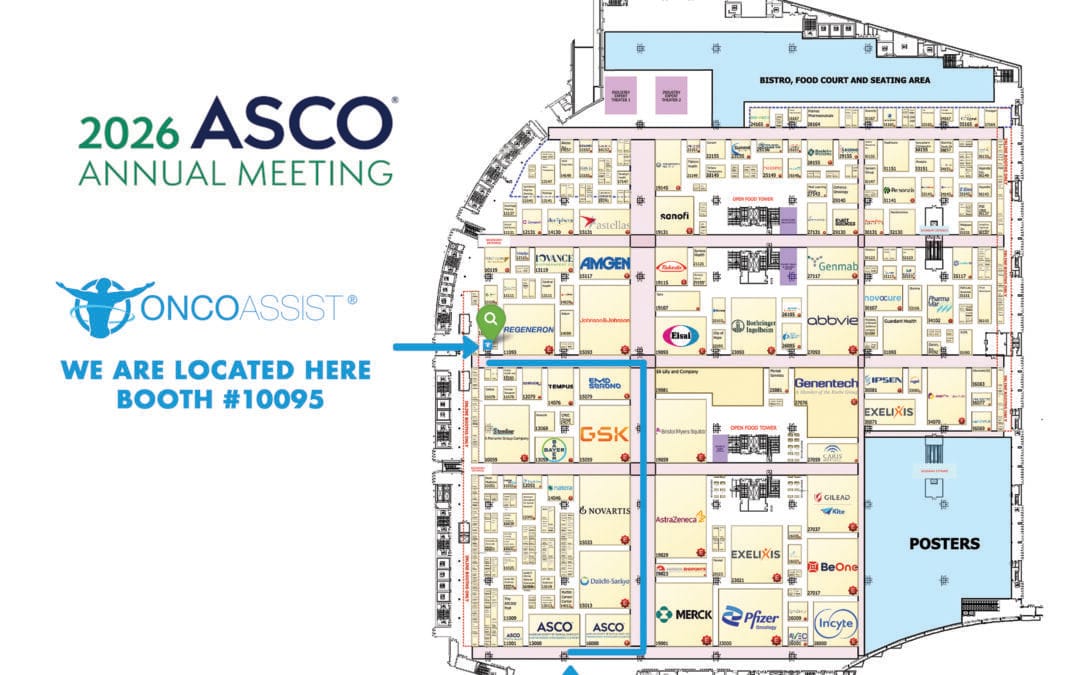
We’re thrilled to announce that ONCOassist will have its first-ever booth at the American Society of Clinical Oncology (ASCO) Annual Meeting 2026. Join us in Chicago this May/June and see how we’re transforming clinical decision support for oncology healthcare professionals.

How to Find Us on the Exhibition Floor

Navigate from the Grand Concourse entrance and head up the main aisle between the ASCO and Merck booths. Continue until you reach EMD Serrano and Johnson and Johnson stand. Turn left at that point and follow the corridor to the end. ONCOassist is on your right- hand side, just past the Regeneron stand.

Note: These directions are specific to the exhibition layout at McCormick Place, Chicago. Look out for signage on the day, or ask a conference volunteer if you need assistance finding our booth. 

We look forward to seeing you in Chicago. #ASCO26 #ONCOassist

ONCOassist Launches ONCO-IQ: A Quiz-Based Learning Feature Bringing Interactivity to Oncology Education

ONCOassist Launches ONCO-IQ: A Quiz-Based Learning Feature Bringing Interactivity to Oncology Education

Killarney, Ireland – 10 November 2025 – ONCOassist®, the world’s leading oncology decision-support platform used by more than 100,000 oncology professionals across 180 countries, has announced the launch of ONCO-IQ, a new quiz-based learning feature that turns oncology education into an engaging, evidence-driven experience.

Designed specifically for oncologists, ONCO-IQ presents short, focused clinical quizzes covering the latest trial data, treatment updates, and evolving standards of care. Each quiz allows users to test their knowledge, view evidence-based explanations, and compare results with peers around the world—all within the trusted ONCOassist environment.

With ONCO-IQ, we wanted to make learning in oncology more interactive, practical, and enjoyable,” said Eoin O’Carroll, CEO and Co-Founder of ONCOassist. “Clinicians are constantly faced with new data and changing guidelines. By transforming this information into concise, quiz-style challenges, we help oncology professionals stay sharp, confident, and informed—without adding to their workload.”

Kevin Bambury, Co-Founder and Chief Commercial Officer of ONCOassist, added:

Pharma and medical education partners are increasingly looking for compliant, measurable ways to reach oncology professionals. ONCO-IQ delivers a science-driven, gamified format that encourages real engagement—allowing partners to support education and awareness initiatives while providing actionable analytics on knowledge uptake.”

Dr. Richard Bambury, Chief Medical Officer at ONCOassist, commented:

As an oncologist, I know how valuable it is to test knowledge in real time. ONCO-IQ brings that opportunity directly into the clinician’s workflow—quick, evidence-based quizzes that reinforce understanding of the latest advances in cancer care. It’s an innovative way to support continuous learning while keeping the focus on patient outcomes.”

Built on ONCOassist’s CE-approved, evidence-based platform, ONCO-IQ offers a compliant, high-impact channel for pharmaceutical and medical-education partners to collaborate on oncology knowledge-reinforcement initiatives. Every quiz undergoes medical review to ensure scientific accuracy, educational integrity, and fair balance.

ONCO-IQ is now available to verified oncologists and physicians in the U.S. through the ONCOassist app and web platform. Access for oncology nurses and allied health professionals is planned for 2026.

About ONCOassist®

ONCOassist is a CE-approved clinical decision-support platform created by Portable Medical Technology Ltd. It provides oncology healthcare professionals with validated calculators, prognostic tools, toxicity management guidelines, staging criteria, and educational resources in one easy-to-use platform. ONCOassist partners with pharmaceutical companies, medical societies, and research organizations to advance oncology education and improve clinical decision-making globally.

Media Contact:
ONCOassist® – Media Relations 📧 eoin@portablemedicaltechnology.com
🌐 www.oncoassist.com

Weekly Oncology Highlights – Powered by ONCOassist

Weekly Oncology Highlights – Powered by ONCOassist

Your go-to digest for the latest breakthroughs in cancer care.

 
From targeted therapies to regulatory shifts, these five developments highlight how precision oncology is reshaping standards of care, empowering clinicians with new tools and broader accessibility.
Leading voices. Big insights. This episode of Oncology Spotlight delivers—scroll down to watch now!


Revolution Medicines Lands FDA Breakthrough for Daraxonrasib in KRAS G12‑Mutant Metastatic Pancreatic Cancer

The FDA has granted Breakthrough Therapy designation to Daraxonrasib, an oral RAS(ON) inhibitor, for previously treated metastatic pancreatic ductal adenocarcinoma (PDAC) with KRAS G12X mutations. In Phase 1 (RMC-6236-001), second‑line metastatic PDAC (progressed within six months of prior therapy), median PFS was 8.1 months (95% CI, 5.9–NE) for KRAS G12X and 7.6 months (95% CI, 5.3–NE) for all RAS‑mutated cases. For third‑line or later treatment with RMC‑6236, median PFS was 4.2 months (95% CI, 4.1–6.4). Among second‑line+ patients with KRAS G12X, ORR reached 20% (16/79) at ≥14 weeks and 27% (13/48) at ≥20 weeks, with a 14‑week DCR of 87%. 

The global Phase 3 RASolute‑302 trial is ongoing, comparing daraxonrasib to standard chemotherapy in G12X (plus expanded G13X and Q61X) cohorts, with dual primary endpoints of PFS and OS. Topline results are expected in 2026. (Reference: Revolution Medicines, Inc. “Revolution Medicines Announces FDA Breakthrough Therapy Designation for Daraxonrasib in Previously Treated Metastatic Pancreatic Cancer with KRAS G12 Mutations.” GlobeNewswire, 23 June 2025)

Amgen Reveals Positive Phase 3 Bemarituzumab Data in FGFR2b-positive Gastric Cancer

Amgen’s Phase III FORTITUDE‑101 trial met its primary endpoint, demonstrating a significant overall survival benefit when Bemarituzumab was added to mFOLFOX6 in FGFR2b-overexpressing, HER2-negative gastric or gastroesophageal junction cancer.
The 547-patient study selected tumors with ≥10% FGFR2b positivity; ocular events (like keratitis and vision changes) and hematologic toxicities were more common in the treatment arm. Detailed efficacy and safety data, along with results from an upcoming chemo+nivolumab combo study, are expected later this year.
(Reference: Amgen Announces Positive Topline Phase 3 Results for Bemarituzumab in Fibroblast Growth Factor Receptor 2b (FGFR2b)‑Positive First‑Line Gastric Cancer.” Amgen Press Release, 30 June 2025.)

FDA Lifts REMS for CAR‑T Therapies

As of June 27, the FDA removed REMS requirements for all FDA-approved BCMA- and CD19-directed autologous CAR‑T therapies—Abecma, Breyanzi, Carvykti, Kymriah, Tecartus, and Yescarta .
Key changes:

(Reference: U.S. Food and Drug Administration. “FDA Eliminates Risk Evaluation and Mitigation Strategies (REMS) for Autologous Chimeric Antigen Receptor (CAR) T Cell Immunotherapies.” FDA Press Release, 27 June 2025.)

FDA Grants Accelerated Approval to Sunvozertinib (Zegfrovy) for EGFR Exon 20+ NSCLC

On July 2, 2025, the FDA granted accelerated approval to Sunvozertinib (Zegfrovy, Dizal (Jiangsu) Pharmaceutical Co., Ltd.) for adults with locally advanced or metastatic NSCLC harboring EGFR exon 20 insertion mutations, following disease progression on platinum-based chemotherapy.
In the WU‑KONG1B trial (n=85), sunvozertinib showed a 46% ORR and median duration of response of 11.1 months
. The FDA also approved a companion diagnostic to identify eligible patients. (Reference: U.S. Food and Drug Administration. “FDA Grants Accelerated Approval to Sunvozertinib for Metastatic Non‑Small Cell Lung Cancer with EGFR Exon 20 Insertion Mutations.” FDA Press Release, 2 July 2025.)

Lynozyfic (Linvoseltamab‑gcpt) Joins Myeloma Armamentarium

The FDA granted accelerated approval to Linvoseltamab‑gcpt (Lynozyfic, Regeneron Pharmaceuticals, Inc.) on July 2, 2025, for adult patients with relapsed or refractory multiple myeloma after at least four prior lines of therapy, including a proteasome inhibitor, IMiD, and anti‑CD38 antibody.
In the LINKER‑MM1 trial, the BCNMA×CD3 engager achieved a 70% ORR, With a median follow-up of 11.3 months
among responders, the estimated duration of response (DOR) was 89% (95% CI: 77, 95) at 9 months and 72% (95% CI: 54, 84) at 12 months. (Reference: U.S. Food and Drug Administration. “FDA Grants Accelerated Approval to Linvoseltamab‑gcpt for Relapsed or Refractory Multiple Myeloma.” FDA Press Release, 2 July 2025.)

This week’s Oncology Spotlight: Dr. Paul O’Brien’s Unconventional Journey into Medicine (Click here to watch)

Dr. Paul O’Brien’s journey—from food science to clinical medicine across China and Ireland now fuels his mission to combat medical misinformation. On Oncology Spotlight, he discusses resilience from his trainingSquare Artwork, an open‑letter moment, AI in decision‑making, and the fight back against pseudoscience and viral influencers. His story is a powerful call for physicians to reclaim the social‑media narrative.


Explore more stories & insights on ONCOassist. Your clinical edge, just a tap away.     


   Screenshot 2025 06 25 at 2.39.33 PM

Join the ONCOassist oncology community, the go-to CE‑approved app for oncology professionals worldwide !
  •  Access essential tools like staging systems, toxicity scoring, drug calculators, prognostic scores and NCCN regimens,all in one place .
  • Stay informed with ONCOnews & ONCOvideos featuring expert insights, conference coverage and peer-tested protocols 
Download the app here:

📱IOS                                  📱Android                              💻 Webapp

Mobilising Hospital Guidelines and Protocols – Every CMO’s Dream

Hospitals and staff operate in a controlled environment where guidelines and protocols are in place. These guidelines and protocols are essential to every hospital as they provide frameworks for working with multi-discipline teams and allow NHS staff to put a standardisation of care into practice. This has a major effect in patient care as it reduces the variation in treatment and thus reduces the chances of error.

Hospitals guidelines and protocols in the UK are all quite similar. They derive from the National Institute For Clinical Excellence (“Nice”). For every hospital, there are variations depending on treatments or staffing availability. As a result every hospital has a vast array of guidelines and protocols, these can reach into thousands of pages.

There are two common ways that all hospitals can access these documents at the moment.

1. Through hard copy books that are distributed to individual staff members.

2. Through the hospital intranet.

Hard copy books are the more traditional means. They cause headaches for both medical staff and the protocol development team maintaining the documents. The obvious headache for hospital staff is the need to carry documents from ward to ward. For the protocol development team there is an issue of document control. With every new edition released, the protocol development team must make sure the out of date document is returned. This can be a logistical nightmare and in some cases there is a concern that out of date documentation is still in use.

The hospital intranet is a more robust system for alleviating problems of document control. But it has its own problems. One of access, even though some medical staff would have their own dedicated PC or laptop the large majority of staff rely on shared computer access. To make things worse, users need to login to the hospital system every time they access shared computers. Searching for the required information can be an issue as the intranet only makes the documentation available through PDF files.

At present the workload and strain on hospital staff is increasing. In order to utilise their time staff may consider not referencing guidelines and protocols. Instead they may rely on past knowledge which could increase the risk of medical error. There is a concern that changes in drug dosages or acute emergency guidance may be overlooked.

It becomes even more of an issue for trainee medical staff who in a lot of cases are placed on 6 month rotations in hospitals. Guidance for these individuals is important. Especially with the short period of time/ learning curve that they need to get up to speed with new hospital environment.  The problem outlined for experienced staff are the same for these trainees. But is magnified with the pressure and time limitations they have at a Trust.

Initiatives like having the NHS paperless by 2018 and the Nursing Technology Fund mean that mobile devices are becoming the norm in hospitals throughout the UK. This has opened up opportunities to change the shape of how hospitals distribute and maintain their guidelines and protocols. Our Enterprise Solution ONCOassist has done just that. The application allows Oncology departments to integrate these documents in an interactive manner..

Our unique interactive format allows users to navigate with ease and speed. There is no need to trawl through PDF’s and paper documents.

Protocol development teams no longer need to worry about document control among staff. Portable Medical Technology use a cloud based system that syncs with mobile devices. It will keep all software and documentation up to date with the latest changes.

ONCOassist’s Enterprise Solution is also Bring Your Own Device (BYOD) friendly. This allows all staff access to critical information. Thus the need to distribute hospital devices to all staff is not needed.

Medical Students no longer need to worry about the vast array of information. The information they need will be in the palm of their hand. The interactive manner allows them to access the most critical information they need. No longer will they have to leave a patient’s bedside to find, to wait, to access, and then go through pdf’s on a computer to find what they need.

ONCOassist provides users with interactive formulas and prognostic tools that are CE approved. Hospitals will be able to notify staff of changes through push notifications and news feeds. Tracking of usage will give hospitals clear indications of adherence.

The benefits are clear.  Reduced time, reduced chances of error and increased quality of care.

If you want further details on ONCOassist’s Enterprise Solution please contact us at info@oncoassist.com